
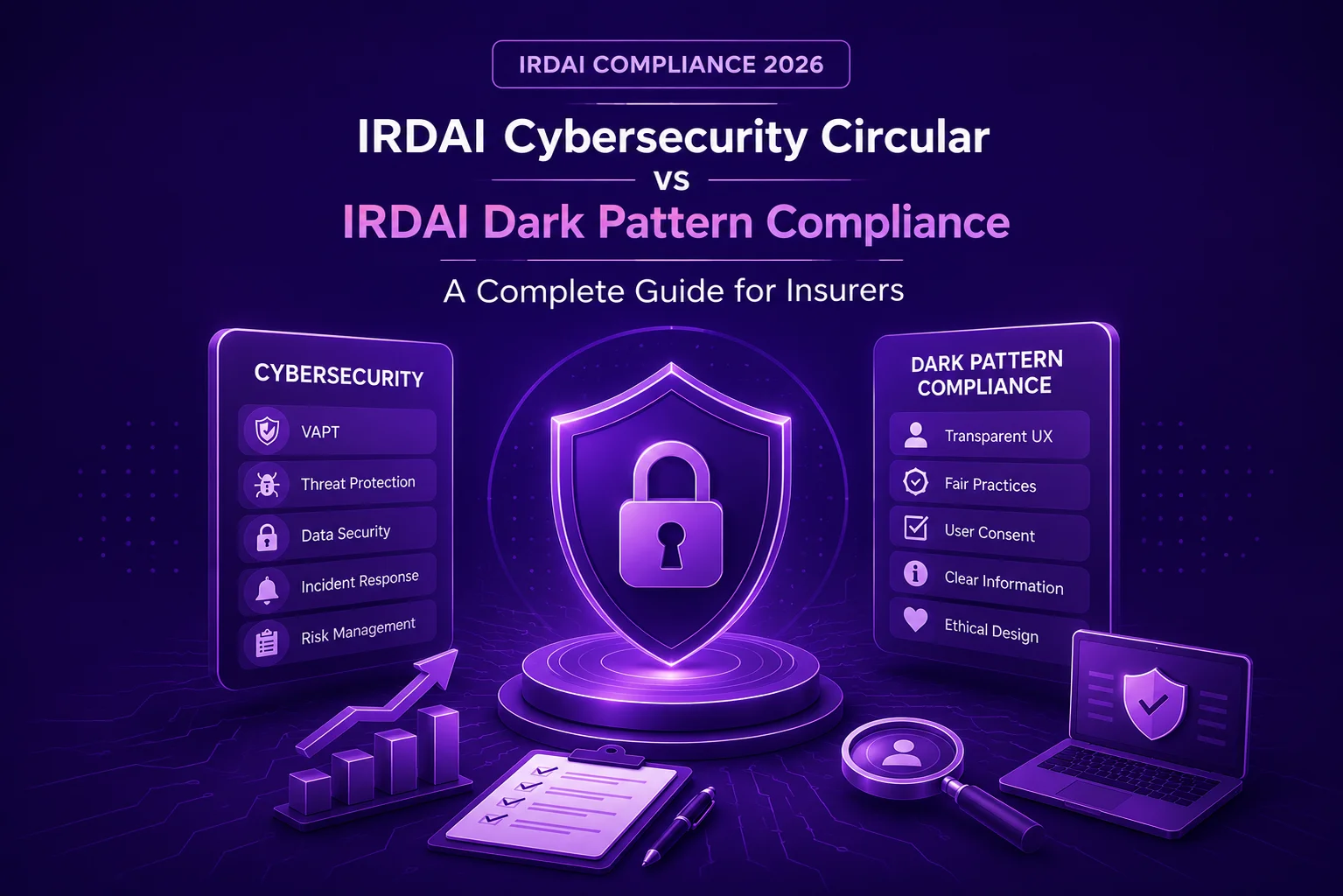
Two IRDAI Circulars. Two Different Risks. One Common Mistake.
Many insurance companies have recently started reviewing the IRDAI Cybersecurity Circular and the IRDAI Dark Pattern Compliance Circular together. While both are issued to strengthen the insurance ecosystem, they address entirely different risks.
The challenge is that many insurers assume these circulars overlap because both involve digital platforms. As a result, organizations often assign the responsibility to a single team, overlooking the fact that cybersecurity and dark pattern compliance require different expertise, controls, and governance.
The reality is simple:
- The Cybersecurity Circular protects your systems, applications, and customer data.
- The Dark Pattern Circular protects your customers from deceptive digital experiences.
Ignoring either can expose insurers to regulatory scrutiny, operational disruption, reputational damage, and erosion of customer trust. This guide explains the difference, why both matter, and how insurers can build a coordinated compliance strategy.
This guide is designed for:
If your organization operates customer-facing digital channels, both circulars deserve executive attention.
Why Do Insurers Get Confused?
One of the biggest misconceptions is that both circulars relate to "digital compliance." While technically true, their objectives are very different.
Many organizations make the following mistakes:
- Assuming cybersecurity assessments also cover dark patterns.
- Treating UX compliance as a marketing responsibility.
- Focusing on regulatory reporting instead of customer experience.
- Conducting annual compliance reviews instead of continuous assessments.
- Reviewing websites while ignoring mobile applications and partner portals.
During digital security and compliance assessments, we often observe that organizations have mature cybersecurity controls but limited visibility into how customer journeys are designed. Conversely, businesses with intuitive digital experiences may still have significant security gaps. Treating these as separate disciplines often creates blind spots.
A Practical Scenario
Consider an insurance company launching a new online health insurance portal. The IT team conducts a Vulnerability Assessment and Penetration Testing (VAPT), secures APIs, and hardens cloud infrastructure. The application passes technical testing.
However, during the purchase journey:
- Add-on riders are pre-selected by default.
- Cancellation options are difficult to locate.
- Consent checkboxes are automatically enabled.
- Pricing information is disclosed only at the final payment stage.
From a cybersecurity perspective, the application is secure. From a consumer protection perspective, it may still violate dark pattern expectations. This illustrates why one assessment cannot replace the other.
Understanding the IRDAI Cybersecurity Circular
The IRDAI Cybersecurity Circular focuses on protecting the confidentiality, integrity, and availability of information systems used by insurers. Its primary objective is to strengthen cyber resilience and reduce the likelihood of cyber incidents affecting business operations.
Organizations are expected to strengthen areas such as:
🛡️ Primary Cybersecurity Business Impact
Strong cybersecurity controls help organizations reduce:
- Data breaches
- Ransomware attacks
- Operational downtime
- Financial fraud
- Regulatory investigations
Understanding the IRDAI Dark Pattern Circular
The IRDAI Dark Pattern Circular focuses on protecting consumers from deceptive or manipulative digital design practices. It aligns with the CCPA Guidelines on Prevention and Regulation of Dark Patterns, encouraging insurers to create transparent, ethical, and customer-friendly digital experiences.
Areas requiring review include:
✨ Dark Pattern Compliance Business Impact
Dark pattern compliance strengthens:
- Customer trust
- Brand reputation
- Regulatory confidence
- Digital transparency
- Customer retention
IRDAI Cybersecurity Circular vs IRDAI Dark Pattern Compliance
To help insurers quickly review how these circulars align and differ, the following comparison summarizes their key characteristics:
| Area | Cybersecurity Circular | Dark Pattern Compliance |
|---|---|---|
| Primary Objective | Protect digital infrastructure | Protect consumers from deceptive practices |
| Primary Risk | Cyberattacks and data breaches | Misleading customer journeys |
| Focus | Systems, networks, applications | User interface and user experience |
| Responsible Teams | IT, Security, CISO | Product, UX, Marketing, Compliance |
| Assessment Type | VAPT, Risk Assessment, Security Audit | Dark Pattern Assessment, UX Review |
| Business Outcome | Cyber resilience | Customer trust and transparency |
| Compliance Goal | Secure operations | Ethical digital engagement |
Why Both Circulars Matter
Cybersecurity and customer experience are no longer separate priorities. An insurer can have a secure infrastructure but still lose customer confidence because of confusing digital experiences. Similarly, a transparent customer journey cannot compensate for weak cybersecurity controls.
Modern insurance companies need both:
- Cybersecurity to protect information and operations.
- Dark Pattern Compliance to protect customer decision-making.
Together, they strengthen digital trust. Navigating these overlapping expectations requires partnering with professional compliance consulting services to avoid regulatory action and safeguard growth.
A Practical Compliance Framework
Instead of treating these circulars independently, insurers should adopt an integrated governance approach.
Step 1 – Assess Cybersecurity Posture
Review networks, applications, APIs, cloud infrastructure, and access controls. Conduct independent VAPT and risk assessments.
Step 2 – Review Customer Journeys
Evaluate policy purchase flow, consent mechanisms, pricing transparency, cancellation process, and marketing practices. Identify potential dark patterns.
Step 3 – Evaluate Third-Party Platforms
Many insurers rely on aggregators, payment gateways, technology vendors, and digital partners. Ensure these platforms comply with both cybersecurity and customer experience expectations.
Step 4 – Strengthen Governance
Establish collaboration between Security Teams, Compliance Teams, Product Teams, UX Designers, and Legal Teams. Digital trust requires cross-functional ownership.
Step 5 – Monitor Continuously
Compliance should not be treated as an annual project. Regular reviews help identify new security risks, emerging dark patterns, third-party issues, and regulatory changes.
Self-Assessment Checklist
Before declaring compliance, ask:
Cybersecurity
- Has an independent VAPT been conducted?
- Are APIs regularly tested?
- Is cloud infrastructure assessed?
- Is incident response tested?
- Are third-party vendors reviewed?
Dark Pattern Compliance
- Are pricing disclosures transparent?
- Are add-ons optional?
- Is consent freely obtained?
- Can customers easily cancel services?
- Are marketing communications clear?
If the answer to any of these questions is "No," your compliance journey is still incomplete.
Frequently Asked Questions
Digital trust is no longer built through cybersecurity alone. It also depends on transparent customer experiences. Insurers that proactively evaluate both their technical security posture and digital customer journeys are better positioned to meet regulatory expectations, reduce operational risk, and strengthen customer confidence. Conducting independent cybersecurity and dark pattern assessments can help identify hidden gaps before they become compliance or reputational challenges.
Schedule a Regulatory Readiness Consultation