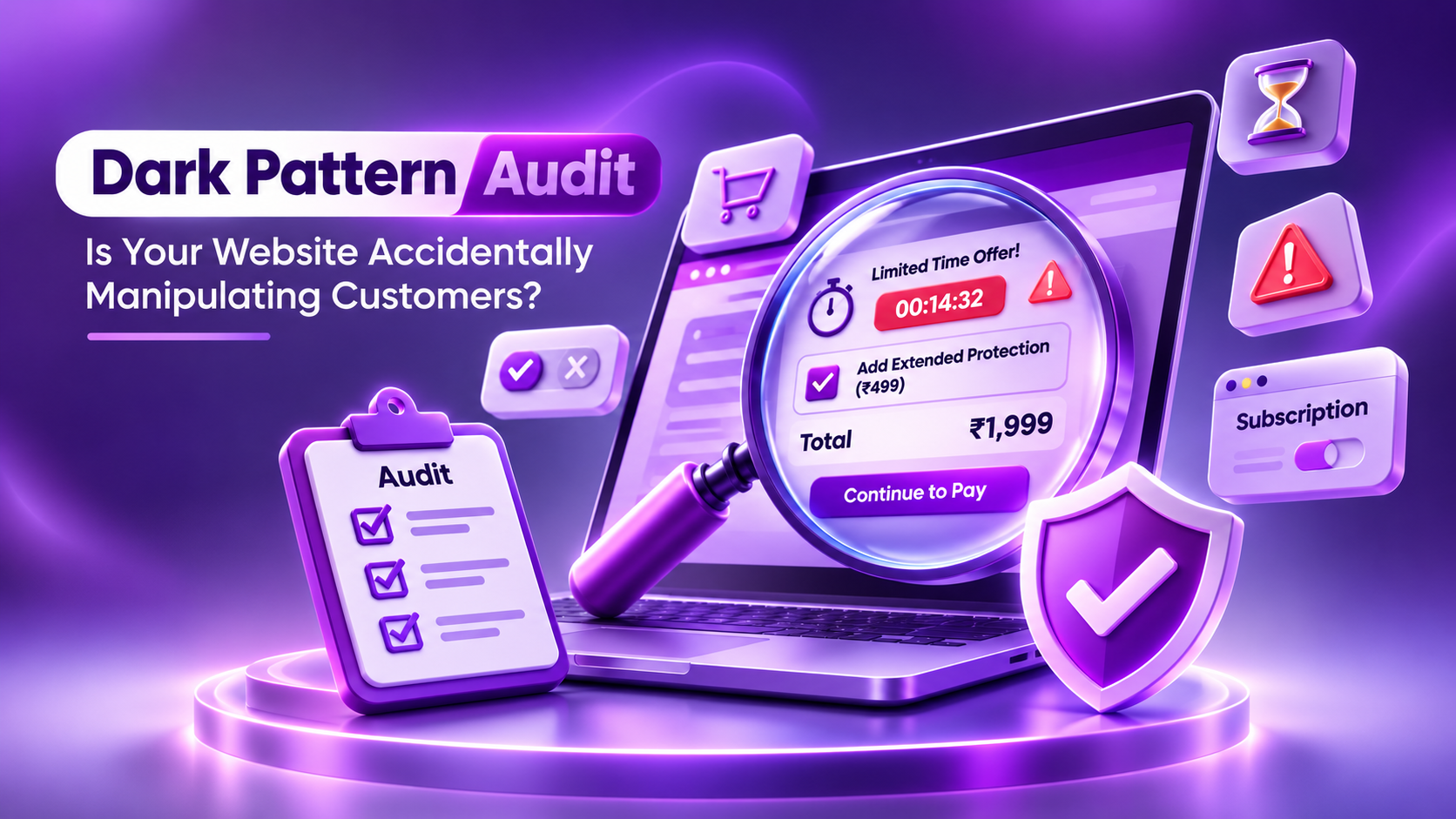
Have you ever tried booking a flight or movie ticket online, only to notice right at the payment screen that a ₹499 travel insurance or convenience add-on was already slipped into your cart without you asking for it? Or maybe you signed up for a 7-day free software trial in two seconds, but when you tried to cancel, you had to call customer support during business hours and answer five retention surveys?
These tricks are called "Dark Patterns". They are clever interface tricks and deceptive designs that nudge, trick, or guilt-trip people into doing things they never meant to do—like spending extra money, signing up for recurring memberships, or giving away personal data.
Here is the surprising truth: most businesses don't set out to trick their customers on purpose. Often, a well-meaning marketing team installs a popular Shopify app or copies an e-commerce template, unaware that the design now violates strict consumer protection laws in India (CCPA 2023 Guidelines), the US (FTC regulations), and Europe (EU Digital Services Act).
Visual Guide: Dark Patterns vs. Honest "Light" Patterns
How customer feelings and business results change when you switch from manipulative tricks to honest design:
- Sneaking items into cart without asking
- Fake countdown timers: "Only 2 minutes left!"
- Guilt-tripping buttons: "No thanks, I hate discounts"
- Hiding the cancel button in deep sub-menus
- All optional add-ons left un-checked
- Real, honest inventory numbers
- Polite, neutral choices: "No thanks" or "Skip"
- Simple 1-click self-service cancellation
What is a "Dark Pattern Audit"?
A Dark Pattern Audit is like a health checkup for your website or mobile app. Just like an accountant audits your books for tax compliance, a UX & cybersecurity team tests your entire customer journey—from your homepage ads and cart checkout to your unsubscribe buttons—to catch any hidden, accidental, or unfair design tricks.
It ensures that your customer feels respected and confident when buying from you, while keeping your business safe from regulatory crackdowns by the Central Consumer Protection Authority (CCPA) in India or the Federal Trade Commission (FTC) in the US.
The Most Common Dark Patterns (And How They Look in Real Life)
Let's look at real-world examples of how dark patterns quietly creep into everyday websites:
🛒 1. "Basket Sneaking" (Auto-Adding Unwanted Items)
STRICTLY ILLEGALHow it happens: You add a ₹1,200 shirt to your shopping cart. When you get to the payment page, the total is suddenly ₹1,289 because a pre-checked box added "Express Delivery Insurance (₹49)" and a "₹40 Donation" without your permission.
😔 2. "Confirmshaming" (Guilt-Tripping the Visitor)
PROHIBITEDHow it happens: A popup appears offering a 10% coupon code. The "Yes" button is bright green, but the exit button says something insulting like: "No thanks, I enjoy paying full price" or "No, I don't care about website security."
🪤 3. The "Roach Motel" (Easy to Enter, Impossible to Leave)
HEAVY FTC FINESHow it happens: You sign up for an online subscription in 1 click using Google Pay. But when you want to cancel, there is no online button! You are told you must dial an international phone number between 9 AM and 5 PM on weekdays.
⏳ 4. False Urgency & Fake Countdown Clocks
MISLEADING ADVERTISINGHow it happens: A flashing red timer says: "Hurry! Deal ends in 04:59!" But if you refresh your browser or open the page in an incognito window, the timer simply restarts at 05:00 again.
💡 The Rule: Only display countdown timers for genuine, real-world events (like a flash sale that truly ends at midnight). Never use a fake JavaScript loop to induce false stress.
How to Run a 4-Step Dark Pattern Audit on Your Own Website
You don't need a massive team to get started. You can walk through your own website right now using this simple 4-step framework:
The "Incognito" Mystery Shop
Open an incognito window on your phone. Pretend you are a first-time customer. Add an item and go all the way to checkout. Did any extra fee or item appear that you didn't click?
The Unsubscribe Test
Try canceling your own paid plan or unsubscribing from your email list. Can you do it in 2 clicks, or do you find yourself jumping through frustrating hoops?
Check Your Apps & Plugins
Look at the conversion widgets and popups installed on your CMS. Are they creating fake stock warnings like "Only 1 left!" even when you have 500 units in your warehouse?
The "Mom Test"
Would you feel comfortable if your mother or non-technical friend bought from your website without you looking over their shoulder? If you'd feel uneasy, you have dark patterns.
Why Honest Design Actually Makes More Money in the Long Run
Some growth marketers fear that removing dark patterns will hurt their numbers. But real data shows the exact opposite:
- ✔ Fewer chargebacks and refund disputes: When people aren't tricked into recurring charges, your payment gateway fees drop and dispute rates disappear.
- ✔ Lower customer support costs: Support tickets asking "Why was I charged this?" or "How do I cancel?" decrease by up to 60%.
- ✔ Customers come back: People buy from brands they trust. Deception works once; honesty works for a lifetime.
How Lumiverse Solutions Helps Your Business Stay Safe & Honest
At Lumiverse Solutions, our team combines cybersecurity testing with UX compliance auditing. We review your website or app just like a regulator would—identifying risky plugins, testing checkout funnels, and giving your developers clear, easy-to-implement design fixes.
Want to make sure your website treats customers fairly and stays 100% compliant? Check out our Website Security & Compliance Audits or talk directly with our advisory team.
Frequently Asked Questions (FAQs)
In simple words, what is a dark pattern?
A dark pattern is a sneaky visual trick on a website or app that nudges you into spending extra money, signing up for something by accident, or giving away personal data you didn't intend to share.
Can a small business be fined for having dark patterns in India?
Yes. Under the CCPA (Central Consumer Protection Authority) Dark Patterns Guidelines 2023, manipulative UI tricks are treated as unfair trade practices under the Consumer Protection Act, 2019. Penalties include fines up to ₹50 Lakhs, forced refunds to customers, and legal orders to take down the tricks.
What is the most common accidental dark pattern?
Pre-checked checkboxes! Many e-commerce stores accidentally keep checkboxes pre-ticked for newsletter signups, package insurance, or recurring delivery. Under current laws, any optional add-on must start unchecked ($0.00) so the customer actively chooses it.
How does a Dark Pattern Audit work?
An auditor inspects every page a customer touches: landing pages, product forms, cart checkouts, popups, and unsubscribe screens. They look for unfair friction, deceptive text, and code loops, and provide a clear report on what needs fixing.
Will removing dark patterns decrease my sales?
Not at all! While you might see a tiny drop in accidental clicks, your refund requests will drop drastically, your customer satisfaction will surge, and customers will be far more likely to return and buy again because they trust your brand.