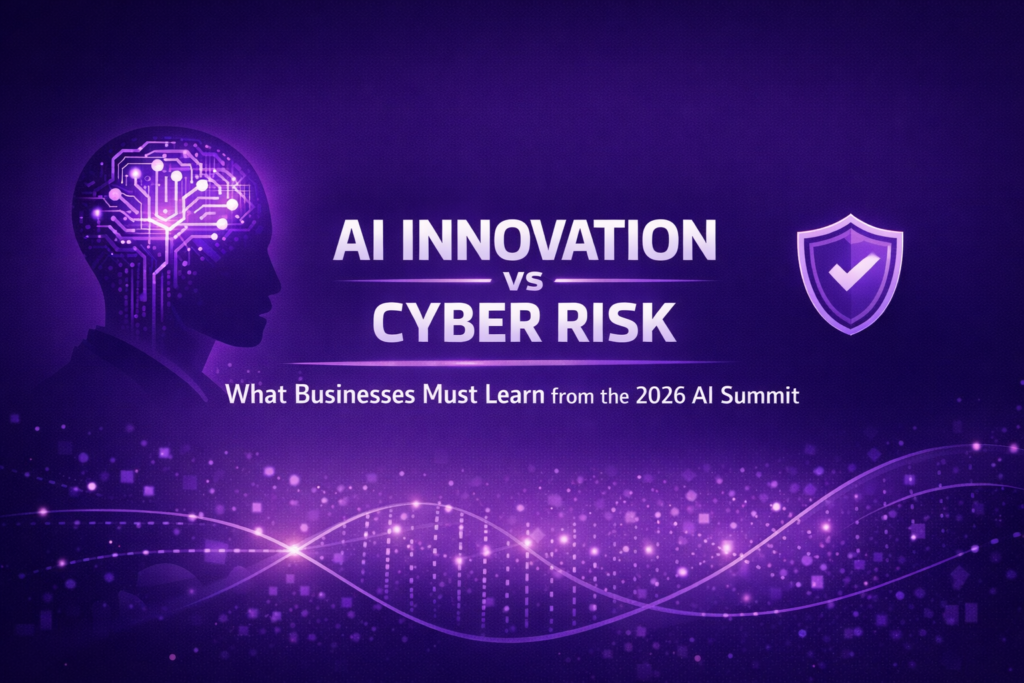
The 2026 AI Summit brought together industry leaders, cybersecurity experts, and AI innovators to address one of the most pressing challenges of our time: how to balance AI-driven innovation with emerging cyber risks.
AI is reshaping business operations, workflows, and threat landscapes across industries. But with this transformation comes a new category of cyber risks that demand proactive defenses and strategic governance.
1. AI Is Accelerating Innovation Faster Than Regulations
A major theme at the summit was the speed of AI adoption:
- AI tools are enabling automation, predictive analytics, threat detection, process optimization, and customer personalization.
- But regulatory frameworks such as data privacy, AI ethics, and cybersecurity requirements are struggling to keep pace.
Businesses must understand that innovation without guardrails can create vulnerabilities, especially when AI systems interact with sensitive data or automate critical decisions.
Action for businesses: Establish clear governance policies for AI initiatives to ensure compliance and safety from the outset.
2. AI Is Both a Cyber Defense Tool and a Cyber Threat Multiplier
Summit experts emphasized a dual reality:
AI strengthens cyber defense by:
- Detecting anomalies faster than traditional tools
- Reducing response times
- Predicting attack patterns
- Automating threat hunting
But AI also empowers attackers to:
- Create adaptive malware
- Automate phishing attacks at scale
- Generate deepfakes for social engineering
- Bypass legacy detection systems
The takeaway?
AI alone is not enough: Human + AI collaboration is the most effective defense.
3. AI Systems Must Be Designed with Security by Default
Security cannot be an afterthought. The summit stressed:
- Integrating security into AI development lifecycles
- Performing continuous testing of models (e.g., adversarial testing)
- Monitoring model inputs and outputs for anomalies
- Ensuring AI models are resilient against data poisoning and manipulation
AI that learns from unsafe or manipulated data can behave unpredictably, creating new risk channels.
Action for businesses: Pair AI development with cybersecurity teams from day one.
4. Explainability and Transparency Are Now Strategic Priorities
Black-box AI models make decisions that are hard to interpret. Regulators and clients alike demand explainable AI.
- Lack of transparency increases compliance risk
- Complex AI decisions without audit trails raise governance concerns
2026 strategy must include explainability standards, especially for systems impacting finance, healthcare, or personal data.
5. AI Governance Frameworks Are Critical
- Clear policies on data usage and model training
- Defined roles and responsibilities
- Risk assessment procedures
- Incident escalation paths for AI systems
- Documentation and auditability
6. The Human Factor Still Matters Most
- Most breaches still occur due to human error
- Employee social engineering remains a top attack vector
- Cultural training and awareness are essential
Action for businesses: Invest in continuous cyber awareness training tailored to AI-related risks.
7. Collaboration Across Sectors Is No Longer Optional
- Businesses
- Governments
- Cybersecurity industry
- AI developers
- Academia
- Lesson 1: AI risk is systemic, not technical
- Lesson 2: Reactive cybersecurity is outdated
- Lesson 3: Governance and ethics must align
How Lumiverse Solutions Helps Balance AI Innovation and Cyber Risk
We help you innovate securely, not just quickly.
Connect With Lumiverse SolutionsConclusion
The 2026 AI Summit underscored a clear reality:
AI innovation and cyber risk are two sides of the same coin.