
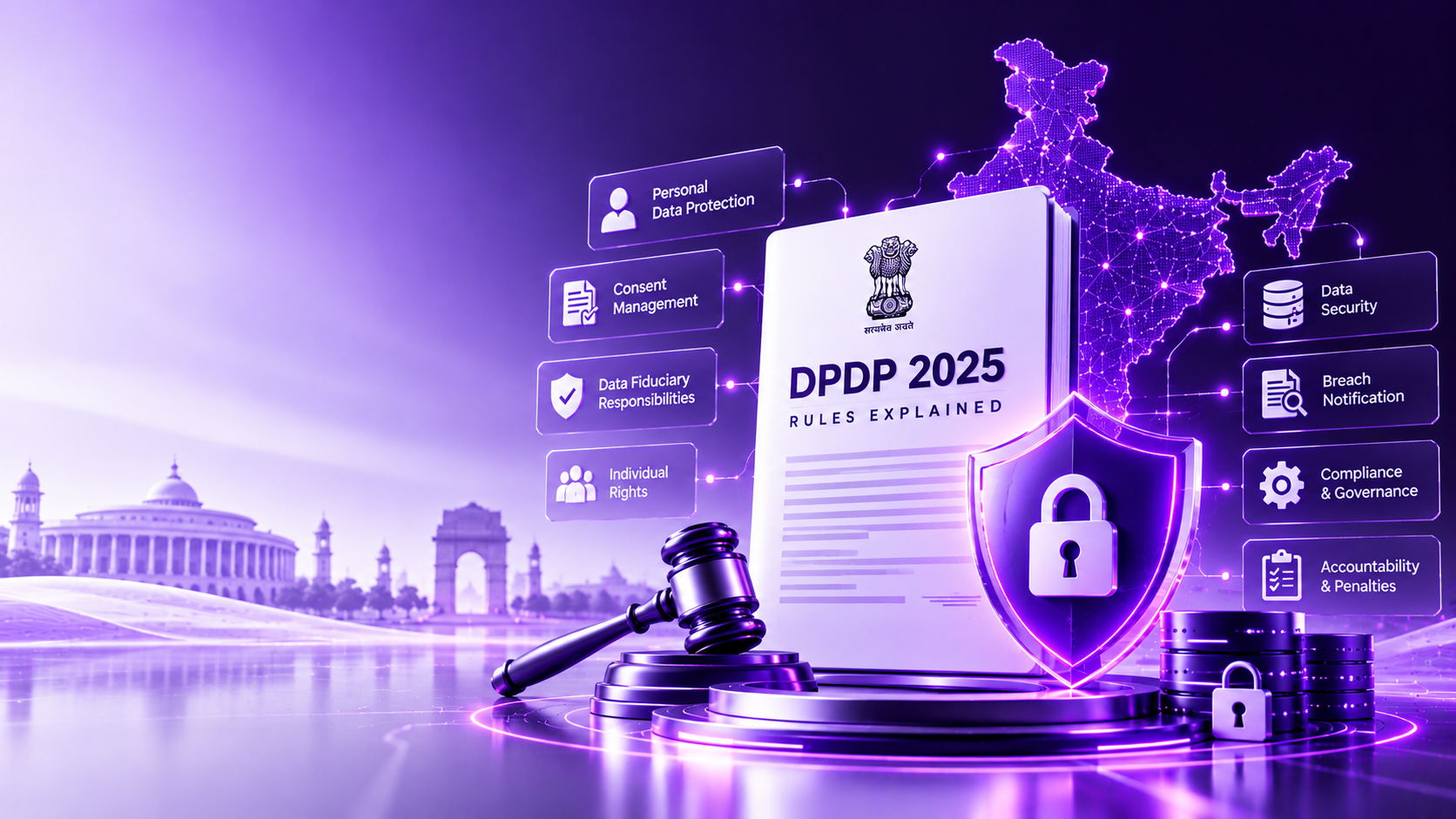
DPDP Compliance in 2026: A Practical Guide for Organizations Handling Personal Data
Many organizations still believe data privacy is a legal checkbox.
It isn’t.
In 2026 and beyond, privacy compliance in India is becoming a business-critical capability tied to trust, cybersecurity, vendor risk, and operational resilience.
The challenge?
Most organizations are still not prepared for what the Digital Personal Data Protection (DPDP) framework demands in practice.
Many assume:
- A privacy policy update is enough
- Cookie banners equal compliance
- Cybersecurity automatically means privacy readiness
Unfortunately, reality is far more complex.
A single failure in how personal data is collected, stored, processed, or shared can create:
- Regulatory exposure
- Customer trust erosion
- Third-party vendor risks
- Legal consequences
- Business disruption
For CISOs, CTOs, Compliance Heads, and leadership teams, the question is no longer:
“Do we need DPDP compliance?”
The real question is:
“How prepared are we for operational DPDP readiness?”
What Are the DPDP 2025 Rules?
The DPDP 2025 Rules require organizations handling personal data in India to implement stronger consent management, improve cybersecurity controls, establish governance frameworks, secure third-party risks, and prepare incident response mechanisms to remain compliant and reduce business risk.
If your organization handles customer, employee, vendor, or user information, the DPDP 2025 Rules impact your operations.
Key priorities organizations should address immediately:
- ✔ Understand where personal data exists
- ✔ Improve consent management mechanisms
- ✔ Strengthen cybersecurity controls
- ✔ Reduce third-party vendor risks
- ✔ Build breach response workflows
- ✔ Align privacy with business governance
Organizations treating DPDP as a one-time legal activity often fail during audits, breaches, or operational reviews.
The organizations that succeed treat privacy as an ongoing governance and cybersecurity function.
Why DPDP Compliance Matters More in 2026
Data privacy is no longer only about avoiding penalties.
Increasingly, organizations face questions from:
- Enterprise clients
- Investors
- Regulators
- Vendors
- Cyber insurers
Questions like:
- “How are you protecting personal data?”
- “Can you prove compliance?”
- “What happens if a breach occurs?”
For sectors like:
BFSI | Healthcare | SaaS | E-commerce | Manufacturing | Education
privacy maturity is becoming a competitive differentiator.
At Lumiverse Solutions, one recurring issue we observe is this:
Most organizations know their infrastructure inventory but struggle to identify where personal data moves across systems, departments, vendors, and cloud environments.
That gap creates hidden compliance exposure.
What Are the DPDP 2025 Rules Really Asking Organizations to Do?
One of the biggest misconceptions is that DPDP is purely a legal framework.
It is not.
The DPDP Rules demand operational accountability.
Organizations must demonstrate responsible handling of personal data throughout its lifecycle.
This includes:
- Collection
- Processing
- Storage
- Sharing
- Retention
- Deletion
1. Consent Must Be Explicit, Traceable & Verifiable
What organizations often get wrong
Many companies still rely on vague consent mechanisms.
Examples include:
- ❌ Pre-checked boxes
- ❌ Unclear policies
- ❌ Broad consent language
What DPDP expects
Consent should be:
- ✔ Specific
- ✔ Purpose-based
- ✔ Easily withdrawable
- ✔ Verifiable
Business implication
Weak consent governance increases:
- Legal exposure
- Customer disputes
- Audit risk
2. Overcollection of Data Creates Hidden Risk
Organizations often collect more information than necessary.
Example:
A business asking for unnecessary customer details during onboarding.
Hidden risk:
The more data you store:
➡ The more you must protect
➡ The greater the liability
Practical question leaders should ask:
“Do we actually need this data?”
3. Cybersecurity Weaknesses Can Undermine Compliance
Privacy without security fails.
A major misconception is believing compliance teams alone solve privacy readiness.
They don’t.
DPDP compliance increasingly depends on:
- Access management
- Vulnerability assessments
- Encryption
- Endpoint security
- Identity controls
- Threat monitoring
Expert Take
Organizations with weak cybersecurity maturity often struggle with privacy readiness because data protection depends on technical security controls.
4. Third-Party Vendors Are a Major Blind Spot
Most organizations process data through:
- HR platforms
- Payroll systems
- CRM tools
- Marketing platforms
- Cloud providers
Hidden reality:
Even if vendors mishandle data, your organization may still carry accountability.
This makes third-party risk management essential.
The 5 Biggest DPDP Readiness Mistakes Organizations Make
Mistake 1: Treating DPDP as Only a Legal Exercise
Privacy compliance requires collaboration between:
- IT
- Security teams
- HR
- Legal
- Leadership
Mistake 2: No Data Discovery Process
Many organizations simply do not know:
- Where personal data exists
- Who accesses it
- How it flows
You cannot protect what you cannot locate.
Mistake 3: Excessive Access Permissions
Too many employees access sensitive information unnecessarily.
This increases:
- Insider threats
- Privacy risks
- Breach impact
Mistake 4: Weak Vendor Governance
Third-party risk remains one of the biggest overlooked compliance failures.
Mistake 5: No Breach Response Framework
Organizations often ask:
“What happens if something goes wrong?”
But many lack:
- Incident playbooks
- Reporting workflows
- Response ownership
DPDP Compliance vs ISO27001: What’s the Difference?
Many leaders assume ISO certification equals DPDP readiness.
Not exactly.
| DPDP | ISO27001 |
|---|---|
| Privacy regulation | Security framework |
| Consent obligations | Risk controls |
| Personal data rights | Information governance |
| Regulatory accountability | Security maturity |
Key insight:
Organizations with ISO27001 maturity have an advantage — but still require privacy-specific governance for DPDP.
A Practical DPDP Readiness Roadmap for Organizations
Instead of reacting late, organizations should adopt a structured roadmap.
| Phase | Objective |
|---|---|
| 1. Data Discovery | Identify personal data |
| 2. Risk Assessment | Find compliance gaps |
| 3. Governance Setup | Define ownership |
| 4. Security Strengthening | Improve protection |
| 5. Vendor Review | Reduce third-party risk |
| 6. Incident Readiness | Prepare response plans |
| 7. Continuous Monitoring | Maintain compliance |
Expert Takeaway
Organizations that succeed with DPDP treat privacy like cybersecurity:
Continuous, monitored, and operational — not checkbox compliance.
How Lumiverse Solutions Helps Organizations Become DPDP Ready
At Lumiverse Solutions, we help organizations move from compliance confusion to practical implementation.
Our services include:
- ✔ DPDP readiness assessments
- ✔ Privacy gap analysis
- ✔ Cybersecurity posture review
- ✔ Vulnerability assessments (VAPT)
- ✔ Vendor risk evaluation
- ✔ Governance & implementation guidance
Whether you are preparing for audits, reducing compliance risks, or strengthening customer trust, Lumiverse helps organizations operationalize privacy readiness.
Decision-Maker Checklist: Are You Really DPDP Ready?
Ask your organization:
- Do we know where personal data exists?
- Can we prove consent?
- Are vendors privacy compliant?
- Are sensitive systems protected?
- Do we have breach response plans?
- Can we demonstrate accountability?
If the answer to multiple questions is uncertain
Your organization likely has readiness gaps.
Conclusion: DPDP is No Longer Optional
The organizations that delay privacy readiness will eventually face:
- Operational risk
- Customer distrust
- Vendor friction
- Regulatory pressure
The organizations that act early will build:
- ✔ Stronger trust
- ✔ Better governance
- ✔ Reduced business risk
- ✔ Stronger cybersecurity maturity
DPDP compliance is no longer just about regulation.
It is becoming a business resilience requirement.
Book a DPDP Readiness Assessment with Lumiverse Solutions
Not sure whether your organization is truly prepared for the DPDP 2025 Rules?
Lumiverse Solutions helps organizations assess privacy gaps, improve cybersecurity readiness, and build practical compliance frameworks.
Schedule a Consultation TodayFAQs
1. What are the DPDP 2025 Rules?
2. Who must comply with DPDP?
3. Is cybersecurity required for DPDP compliance?
4. Does ISO27001 guarantee DPDP compliance?
5. How can organizations prepare for DPDP?
Internal Linking Suggestions
- DPDP Services
- VAPT Services
- SOC as a Service
- Cloud Security Assessment
- Cybersecurity Compliance Services
Lumiverse Solutions Helping Organizations Build Practical Privacy & Cybersecurity Readiness.