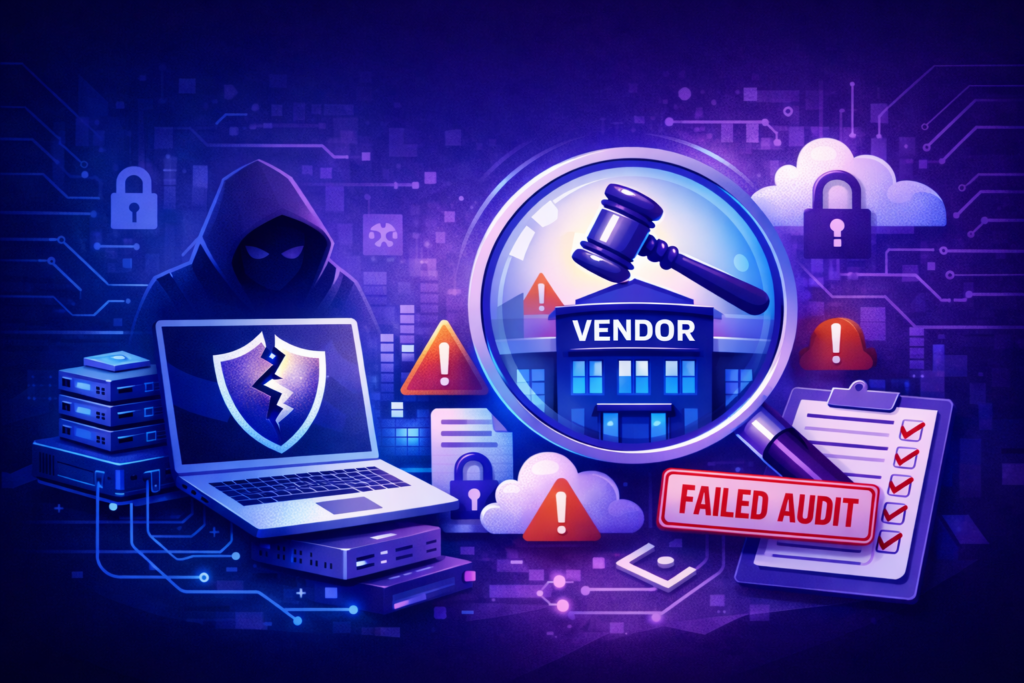
In 2026, most compliance failures are no longer caused by internal system weaknesses alone. Instead, regulators across sectors are consistently identifying vendor and third-party risk as the single biggest reason organizations fail cybersecurity and data protection audits.
From cloud service providers and SaaS platforms to IT support vendors and outsourced operations, businesses today depend heavily on third parties. While this improves efficiency, it also expands the attack surface often beyond direct control.
This blog explains why vendor risk has become the top compliance failure in 2026, what regulators are actually checking, and how organizations must strengthen third-party governance.
Why Vendor Risk Has Escalated in 2026
Modern organizations rarely operate in isolation. Core systems, data processing, monitoring, customer support, and analytics are frequently outsourced or cloud-based.
Regulators have observed that:
- Many cyber incidents originate at vendors
- Breaches often involve shared credentials or unmanaged access
- Vendor security assessments are outdated or missing
- Organizations lack visibility into vendor environments
As a result, regulators now treat vendor failures as organizational failures.
What Regulators Expect for Vendor Risk in 2026
Across cybersecurity and data protection frameworks, vendor risk expectations have tightened significantly.
Regulators now expect organizations to demonstrate:
- Clear identification of all third-party vendors
- Risk classification based on data access and system criticality
- Documented vendor security assessments
- Ongoing monitoring of vendor activities
- Defined accountability for vendor incidents
Vendor governance is no longer a paperwork exercise; it must be operational and continuous.
Common Vendor Risk Gaps Found During Compliance Audits
Based on 2026 audit trends, the most frequent vendor-related gaps include:
1. No Formal Vendor Risk Classification
Many organizations treat all vendors the same.
Regulators expect vendors to be categorized as high, medium, or low risk based on access to systems and data.
2. One-Time or Outdated Vendor Assessments
Vendor security checks are often performed only during onboarding.
In 2026, auditors expect periodic reassessments, especially after system changes or incidents.
3. Unmonitored Vendor Access
Common findings include:
- Shared credentials
- No MFA for vendor access
- Persistent access even after contract expiry
Uncontrolled access is a major audit red flag.
4. Weak Contractual Cybersecurity Clauses
Many contracts lack:
- Security control requirements
- Incident reporting timelines
- Audit rights
- Data handling obligations
Contracts are now reviewed closely during audits.
5. No Vendor Incident Response Integration
When incidents occur at vendors, organizations often lack:
- Clear escalation paths
- Incident notification timelines
- Joint response procedures
This delays regulatory reporting and worsens impact.
6. Limited Visibility into Cloud and SaaS Vendors
Organizations struggle to demonstrate:
- Where data is stored
- Who can access it
- How security is monitored
This gap is especially critical for privacy compliance.
Why Vendor Risk Directly Impacts Compliance Outcomes
Vendor-related failures affect multiple compliance areas simultaneously:
- Cybersecurity resilience
- Incident reporting obligations
- Data protection requirements
- Audit evidence completeness
- Regulatory trust
In 2026, even strong internal controls cannot compensate for weak vendor governance.
What Businesses Must Do to Fix Vendor Risk in 2026
To remain compliant, organizations must move to continuous vendor risk management.
Key actions include:
- Maintain an updated vendor inventory
- Classify vendors based on risk
- Perform periodic security assessments
- Enforce MFA and least-privilege access
- Monitor vendor activity through logs
- Update contracts with cybersecurity obligations
- Integrate vendors into incident response plans
- Maintain audit-ready evidence
Vendor risk management must be treated as a core compliance function, not a procurement task.
How Lumiverse Solutions Helps Manage Vendor Risk
Lumiverse supports organizations with:
- Vendor risk gap assessments
- Third-party security evaluation frameworks
- Continuous monitoring and access governance
- VAPT for vendor-exposed systems
- Contractual cybersecurity requirement guidance
- Incident response integration for vendors
- Audit-ready documentation and reporting
Lumiverse Solutions Pvt Ltd helps organizations reduce vendor-driven compliance failures and stay inspection-ready throughout the year.
Conclusion
In 2026, vendor risk is no longer a hidden issue; it is a leading cause of compliance failure. Regulators expect organizations to take full accountability for the security and data protection practices of their third parties.
Organizations that proactively manage vendor risk will face fewer audit observations, faster incident response, and stronger regulatory confidence.
Connect with Lumiverse Solutions to strengthen your vendor risk governance and avoid compliance failures in 2026.
Tell Us Your Opinion
We value your perspective! Share your thoughts, feedback, or questions below. Your opinion matters and helps create a richer, more engaging conversation. Let’s connect and hear what you think about this post!